
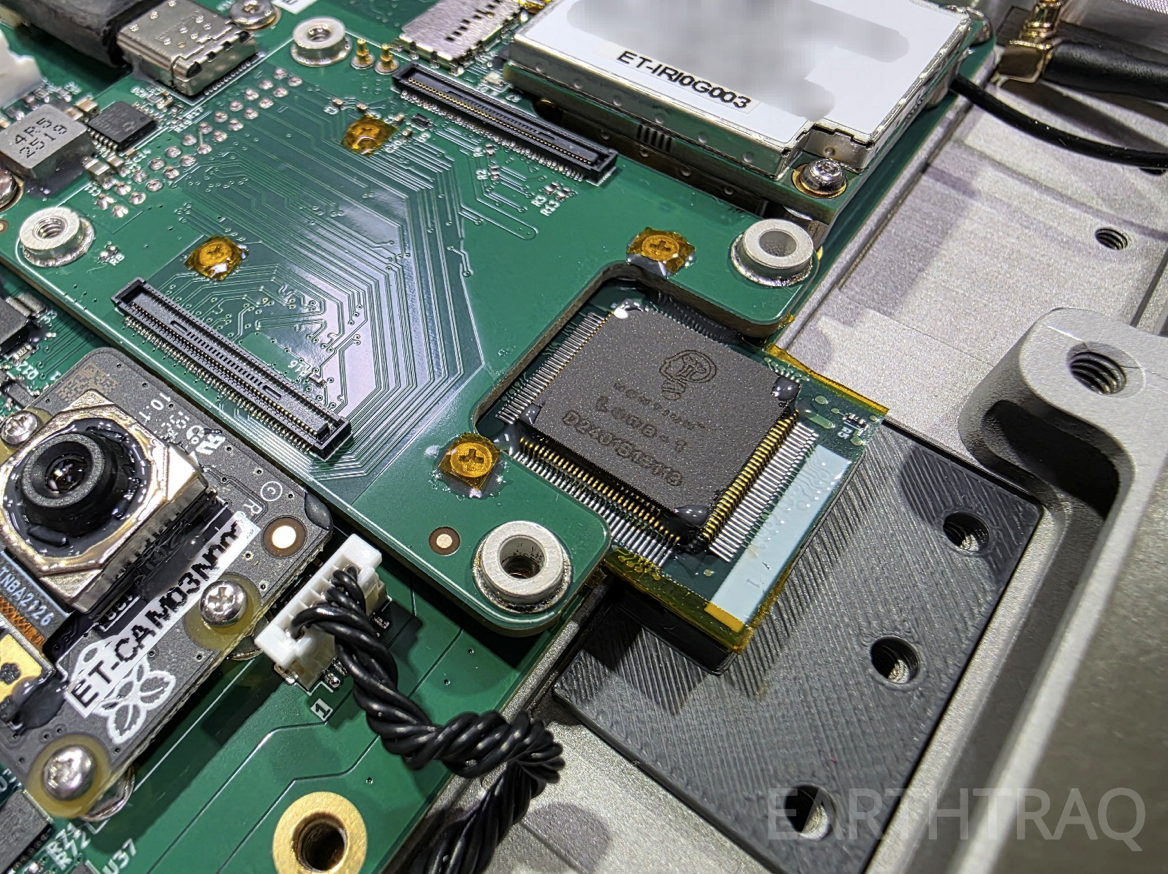
Launching on SpaceX Transporter-17 to Enable Autonomous Intelligence Across LEO Satellite Networks
Goleta, CA — May 28, 2026 — Mentium Technologies today announced that its next-generation AI processing chip, Luna-R1, has been selected for deployment on the ET-01 mission, a constellation of satellites operating in Low Earth Orbit (LEO). The constellation is being developed by EarthTraq, previously operating in stealth, with mission sponsorship provided by NASA’s Small Spacecraft and Distributed Systems (SSDS) project. Each of EarthTraq’s four spacecraft comprising the ET-01 mission will carry a Mentium Luna-R1 board and is scheduled for launch aboard SpaceX’s Transporter-17 rideshare mission. This milestone marks a significant advancement toward scalable, distributed onboard intelligence for next-generation space architectures.
By processing data in space rather than relying solely on downlink bandwidth, Luna-R1 enables faster decision cycles, reduced latency, and more efficient constellation-wide operations.
“Constellations fundamentally change how space systems operate—from isolated spacecraft to coordinated, intelligent networks,” said Mirko Prezioso, CEO of Mentium Technologies. “Luna-R1 enables each satellite to perform local AI inference while contributing to a broader distributed system, unlocking a new class of autonomous space capabilities.”
Enabling Distributed Intelligence in LEO Constellations
Luna-R1 integrates advanced AI acceleration, radiation-tolerant design principles, and ultra-low-power compute into a compact package optimized for spaceflight and scalable constellation deployment. Key enabled capabilities include:
- Real-time data ingestion from onboard sensors and payload instruments
- On-orbit AI inference for classification, anomaly detection, and predictive analytics
- Distributed processing across the constellation, enabling coordinated and adaptive operations
- Low-latency transmission of processed insights to ground operators and network nodes
- High reliability under thermal, radiation, and power-limited conditions
Powering the Next Generation of Autonomous Space Systems
As satellite architectures evolve toward large-scale constellations, onboard intelligence is becoming essential to manage increasing data volumes and mission complexity. Luna-R1’s selection for ET-01 underscores the growing demand for scalable, energy-efficient AI hardware that can operate reliably in space while enabling real-time decision-making at the edge.
“This mission is a key step toward fully autonomous orbital systems,” added Mirko Prezioso. “By embedding intelligence across an entire constellation, we enable faster response times, reduced operational overhead, and entirely new mission capabilities—from persistent Earth observation to adaptive communications and beyond.”
Looking Ahead: Luna-2
Building on the success of Luna-R1, Mentium Technologies is developing Luna-2, its next-generation AI accelerator delivering 4.2 TOPS of compute performance at just 150 milliwatts of power consumption. This dramatic leap in performance-per-watt positions Luna-2 as one of the most power-efficient AI processors available for space (Luna-R2) and edge applications. Designed for both radiation-tolerant and standard-grade configurations, Luna-2 will extend Mentium’s reach across constellation-scale deployments, autonomous systems, and dual-use markets spanning defense, commercial IoT, and next-generation Earth observation platforms.
About Mentium Technologies
Mentium Technologies develops advanced AI compute solutions for aerospace, defense, commercial IoT devices, and next-generation embedded systems. With a focus on reliability, efficiency, and mission-critical performance, the company delivers hardware and software technologies that enable intelligent operations in the most demanding environments.