
Phase I effort will define a radiation-hardened architecture intended to bring onboard AI and greater autonomy to power-constrained space platforms
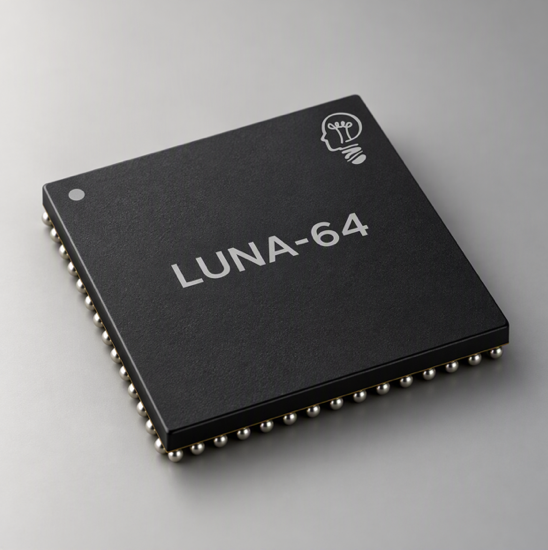
Rendering of the Luna-64 AI co-processor for future space systems.
GOLETA, California – October 12, 2026 – Mentium Technologies today announced that it has been awarded a NASA Small Business Innovation Research (SBIR) Phase I contract to develop the architectural foundation of Luna-64, a next-generation radiation-hardened artificial intelligence co-processor intended to bring advanced onboard intelligence to power-constrained spacecraft and autonomous space systems.
The project will be performed under NASA Contract 80NSSC26C0271.
The award comes as onboard artificial intelligence is becoming increasingly important to government and commercial space missions. Growing sensor-data volumes, limited communications bandwidth, and the delay associated with operating far from Earth are increasing the need for spacecraft to analyze information locally and support mission operations with greater onboard autonomy.
Luna-64 is being developed to address this challenge by enabling onboard perception, intelligent processing, and decision support within the stringent power, size, weight, and reliability constraints of spaceflight hardware. If successfully developed through subsequent phases, the technology could support scientific event detection, image classification, anomaly detection, optical navigation, intelligent sensor processing, and mission-data prioritization.
The proposed architecture is designed as a scalable, PCIe-attached AI co-processor that could complement NASA’s High-Performance Spaceflight Computing ecosystem while allowing a qualified host processor to remain responsible for command, control, telemetry, fault management, and core flight software.
| “The future of space exploration depends increasingly on giving spacecraft the ability to interpret information and support operations without waiting for continuous direction from Earth,” said Mirko Prezioso, Co-Founder and CEO of Mentium Technologies. “AI is becoming a strategic capability for space missions, but space-qualified computing remains constrained by power, size, and reliability requirements. Luna-64 is designed to help bridge that gap by bringing cognition to power-constrained platforms and enabling a new generation of autonomous spacecraft, scientific instruments, robotic explorers, and distributed space systems.” |
The Phase I program will focus on defining and evaluating the Luna-64 architecture, including its performance and power targets, memory hierarchy, software stack, reliability mechanisms, PCIe dataflow, physical-design considerations, and integration with emerging spaceflight computing platforms. The work will build on Mentium’s prior NASA-funded development of the Luna family of ultra-low-power AI processors for aerospace applications.
Potential applications include Earth observation, lunar and planetary exploration, autonomous science platforms, robotic surface systems, distributed satellite constellations, and deep-space missions where communication delays make continuous ground supervision impractical. The proposed architecture also addresses multi-asset systems in which spacecraft, vehicles, and sensors perform local AI inference and coordinate mission activities.
The NASA award advances Mentium’s work toward an architecture for intelligent space computing. If the technology is successfully matured, Luna-64 could contribute to future platforms that move space systems beyond data collection toward more autonomous onboard analysis. The same architectural foundation will also have potential applications in defense, robotics, industrial automation, and other edge-computing environments with strict power constraints.
About Mentium Technologies
Mentium Technologies is a fabless semiconductor company developing ultra-low-power AI processing solutions for aerospace, defense, autonomous systems, and edge-computing applications. The company’s Luna family of AI processors combines neural-network acceleration, heterogeneous computing, and energy-efficient design to enable intelligent operation in environments where power, size, weight, and reliability are mission-critical.